The Oxford Dictionary’s definition of the term “sports-washing” is “to use sport or a sporting event to promote a positive public image for (a sponsoring or hosting government, organization, etc., or its actions or reputation), and as a means of distracting attention from other activities considered controversial, unethical, or illegal”. There’s many media headlines accusing Saudi Arabia of attempting to do exactly that and around a week ago at the time of writing, the Independent reported that the World Cup 2034 violated FIFA’s own human rights regulations. When looking at issues closer to home, the BBC reported that campaigners in Newcastle (home of PIF-owned Newcastle United) have met with the city’s council leader to demand action against alleged “sports-washing”. Formula 1 have also been criticised for “being complicit” in alleged Saudi wrongdoings due to the recently added Grand Prix in Jeddah, whilst the recent wave of big-money transfers to the Saudi Pro League also has some public dislike, but this is partly due to good players leaving Europe. Indeed, it appears that Saudi Arabia has come under scrutiny in its efforts to further integrate the nation into world sport, however that goes without saying that the country has benefitted as well. They will no doubt hope that the Saudi World Cup will be the biggest jewel in their alleged “sports-washing” crown after the tournament’s 2022 success in Qatar, but in this section of the series I’m going to explain quite how well it’s going so far.

Newcastle United
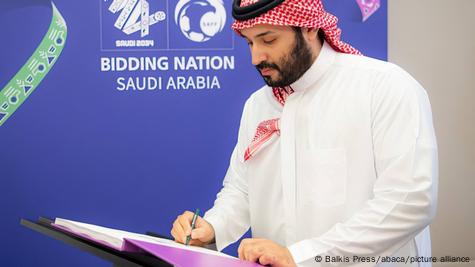
On Friday the 8th of October 2021, the Premier League confirmed that the Saudi Arabian Public Investment Fund had bought an 80% controlling stake in Newcastle United. They had given the deal the green light after “legally binding assurances” that the Kingdom would not control the club. That may sound slightly dubious given that the same Mohammed bin Salman that is the de facto ruler of Saudi Arabia is also the chairman of the PIF, backed up by the fact that text messages from former minority co-owner Amanda Staveley suggesting that the Crown Prince was heavily involved in the takeover were leaked in 2024. The Premier League decided to not review the sale. Despite fans of rival clubs understandable unrest around a club accused of being “state-owned”, Newcastle United have been exceptionally successful and well-run since the takeover- something that Saudi Arabia will no doubt hope people see as a metaphor for their country. Soon after taking ownership, Eddie Howe replaced Steve Bruce as manager, and an array of statement signings (for a club of their level at the time) followed. Within six months, Newcastle had been lifted from the relegation zone to mid-table. Heavy investment came once again the next Summer, but this still didn’t stop a top four (Champions League qualification) finish surprising many. The Tyneside club disappointed in the league (finishing 7th) the next season, however this was generally viewed as acceptable given how being in the Champions League strains a side when it has so recently shot up the table. They may have finished bottom of their group on the continent, but a notable 4-1 victory over Qatari-owned Paris Saint-Germain would no doubt of impressed the PIF.
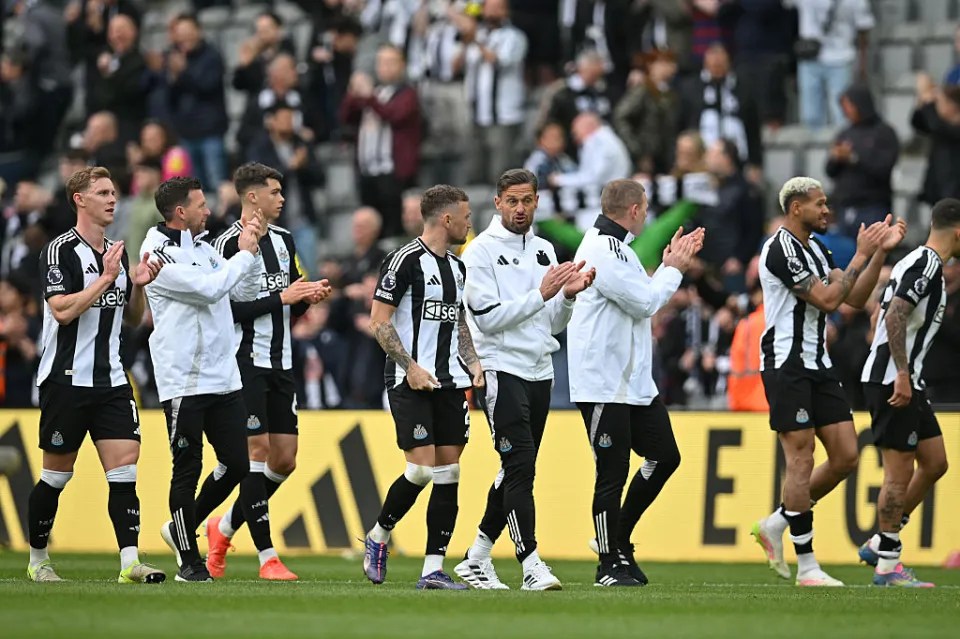
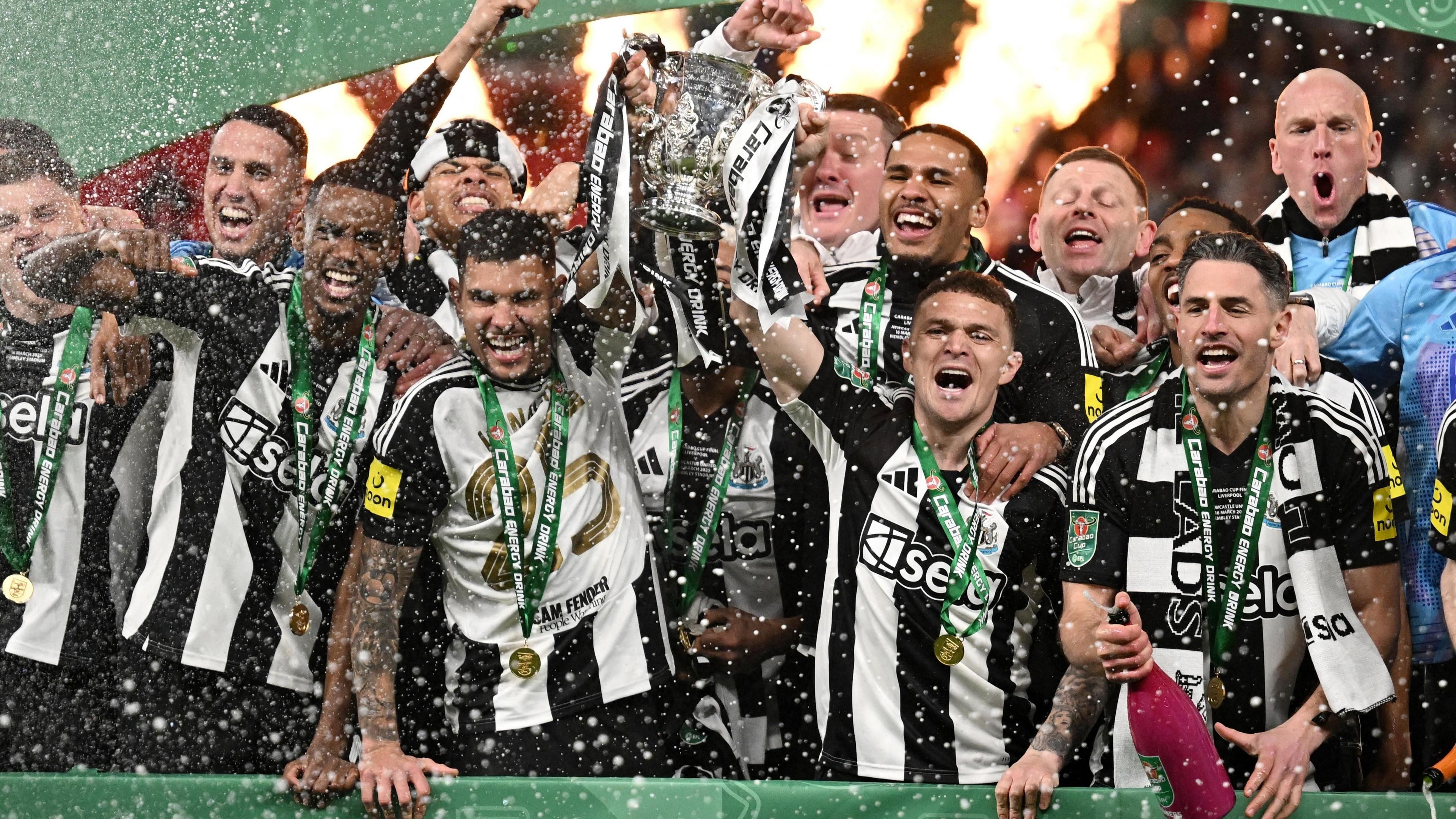
(Newcastle players celebrate win over Man United (The Sun) Newcastle players celebrate Carabao Cup victory (The BBC))
In the most recent season, Newcastle were unable to spend as much money due to Premier League profit and sustainability regulations, but that didn’t stop them roaring back into the Champions League places. Not only that, but the Saudi ownership certainly upped their reputation within the “toon” fan-base when the club delivered their first major trophy in 56 years with the 2025 Carabao Cup triumph. Admittedly, the focus wasn’t on the PIF’s success at the time, but the win received huge media attention in a very positive light. Not only are they now loved by Newcastle fans, but since the take-over the club have been viewed as being exceptionally successful and well-run compared to before-hand, which has led some fans to change their view on the PIF’s ownership. The club have certainly improved since October 2021, and whilst many are still angered by a “state-owned” side, I’m in no doubt that the possession of a foreign football team has served Saudi Arabia well so far. Bin Salman will surely hope that what people see in the well-run, successful nature of a PIF-owned Newcastle will transfer across to their opinion of his state, no matter how much he truly was involved in the takeover.
Roshn Saudi Pro League
On Christmas Day 2022, Saudi Arabian football club Al Nassr had fewer than 900,000 followers on Instagram. A week after New Year’s Day they had more than 10 million. Now they have nearly 28 million. In case you weren’t aware, in the two weeks between the two former follower counts stated, Cristiano Ronaldo signed for the club. The Portuguese is the kind of name those who have no interest in football whatsoever still have heard of. Not only is he a house-hold name, but he also is the most followed person on Instagram- and now has more than 1 billion followers across social media as a whole. Perhaps online statistics like I’ve just stated aren’t the best way to fully judge change, but the drastic increase in Al Nassr’s popularity is just too big to ignore. What we didn’t know when Cristiano Ronaldo signed that 200 million pound-per-year salary, was that his gargantuan drop in the water would lead to many more enormous waves.
It isn’t just ordinary people who are influenced by and admire the striker- it’s football players too. Nowadays football is often a sport where unfortunately money is the one true power. This is none more evident than with the rise of the Saudi Pro League. In the Summer after Ronaldo’s Winter move, many more of Europe’s finest followed the cash to Saudi Arabia- Benzema, Neymar, Kante and Mane were amongst the huge, yet aging names to arrive, but perhaps a more stunning statement of intent from the Saudis was that many of Europe’s younger players were being prized away too. It was obvious that the Kingdom didn’t just want their Pro League to be a retirement one, or a PR stunt of players whose legs were long gone for European standard, but that they desired a competition that could rival major leagues in the long term. The transfer door hasn’t closed and the money hasn’t dried up yet, as many secretly worried football fans predicted, but it’s clear the Saudi Pro League still has a long way to go- there are still many issues.
Indeed, big names going to Saudi Arabia has attracted eyes to the nation, but the reasons of players going there is not yet respected. Whilst some may want to view themselves as footballing missionaries in a far off land, others have been frank about their motivations of going to the Middle-East- the lure of generational wealth. Also, to use a rather simple metaphor, yes the overall ceiling of the league has been bettered (look at the star players now compared to four years ago), but the floor is still the same, and not to be rude, but certain players make a mockery of others- this has also impacted the development of Saudi Arabian footballers. The fact that the four of the league’s top teams (Al Ittihad, Al Nassr, Al Hilal and Al Ahli) are all owned by the Public Investment Fund not only creates a gulf in competition, but a sense of disinterest in Europe. Football fans love clubs “competing against each other” and when they’re all owned by the same company that is lessened. Not to mention the fact that European players are routinely linked to “Saudi” rather than individual teams.
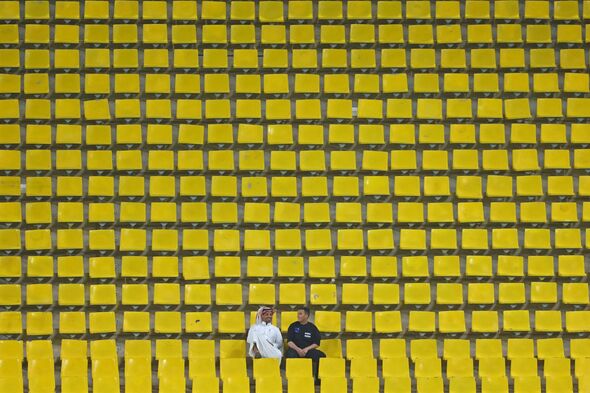

(Empty seats at Saudi stadium (The Express) Benzema and Diaby celebrate victory (CGTN))
The largest problem that Saudi Arabia have failed to tackle in their domestic league so far is viewership. Even myself, and many other fans in Europe are surprised by quite how big the level of disinterest in the league is. In truth, I personally know no-one who regularly, or even has ever watched the Roshn Saudi Pro League, and I doubt they do too. Perhaps the most shocking and worrying measure of interest for the Kingdom is the number of people actually turning up to stadiums to watch the game. I find it stunning and a little strange that they can add so many well-known names, yet viewing numbers actually decreased between 22/23 and 23/24- the Express reported that in a mid-table clash between Damac and Al Riyadh only 89 supporters turned up to a 22,188 capacity stadium. These numbers highlight that interest in the league itself is still very low, and most fans only turn up to games involving the top five-seven teams who have big-name players signed from Europe. From an outsider point of view, it seems that so far, the Saudi FA have created a league where people prefer to watch players rather than teams. I have no doubt whatsoever that there are many loyal and passionate fans for each of the league’s clubs, but I also don’t question that people turning up to watch Cristiano Ronaldo rather than Al Nassr (for example) hinders the Roshn Saudi Pro League’s quest to become a league comparable to a top European one. Whether it was a shot aimed at eternal rival Lionel Messi or not, Ronaldo’s comment that the Saudi Arabian top flight is better than the French League 1, because “France only has PSG, the rest are finished” appears to have no logic or grounding. The contrast between top of the league Al Ittihad and bottom of the division Al Raed is much larger in terms of quality than Paris Saint-Germain and Montpellier in France, whilst again, without trying to be rude, little has changed at the bottom of the division since the Ronaldo transfer moment, and sides towards the relegation zone lack the quality for the league to be seen as a contender for the top five in Europe at the moment, not to mention the state of many better teams benches being a way off those in “l’hexagon”.
Taking all into account so far, I do see a world where the Saudi Pro League is seen as a top one even compared to Europe (the top Saudi clubs admittedly are superior to Asia’s others), if they start to improve the floor, not just the ceiling, and carry on investing money to attract more fans to games for the club instead of the players. I’m sure there are many in Europe happily revelling in the fact that you can buy the best players, but not necessarily the best fans- that is something where you just need to trust time. Doing exactly that is something that Saudi Arabia may have to do for their domestic league. They’ve certainly attracted the eyes of football fans so far, but at this moment I’m unsure whether it’s in a positive way. Many here at home are frustrated with players leaving behind tradition and grandeur for “generational wealth”, but for the many who grew up in poverty, who can really blame them? Also, it would be slightly arrogant and self-centred for a European not to acknowledge how the league’s growth has affected Saudi nationals- I’m sure they’re delighted to have the opportunity to see players that they’d previously have to take expensive “holidays” to watch in the flesh. As for Saudi Arabia allegedly using their domestic league to make people see them in a positive light, they may just have to let time do its work, in order to create a competition with the same sense of life and fan involvement as those in Europe.
Jeddah Grand Prix
In the midst of the 2020 Covid-19 pandemic, Formula 1 announced a new addition to its 2021 calendar. The night race would “take place on Jeddah’s corniche, which runs along the banks of the Red Sea, providing a stunning coastal backdrop for a full weekend of live motorsport”. F1’s chairman and CEO Chase Carey was also keen to add that “Saudi Arabia is a country that is rapidly becoming a hub for sports and entertainment” and that “the region is hugely important to us and with 70% of the population of Saudi being under 30 we are excited about the potential to reach new fans”. From his statements around the Grand Prix’s introduction, it can clearly be seen that Saudi Arabia wasn’t just desperate for F1 (Sports Minister Prince Abdulaziz said that “Saudi Arabia is accelerating forward and the speed, energy, excitement of Formula 1 perfectly reflects the transformational journey the country is on”), but that Formula 1 was desperate for Saudi Arabia. The racing competition saw just how much potential a young, sports-eager population had, and the Kingdom saw yet another opportunity to guide foreign eyes towards their nation, this time for an exhilarating weekend of motorsport, which their Sports Minister quite literally stated was a brilliant metaphor for the country itself.
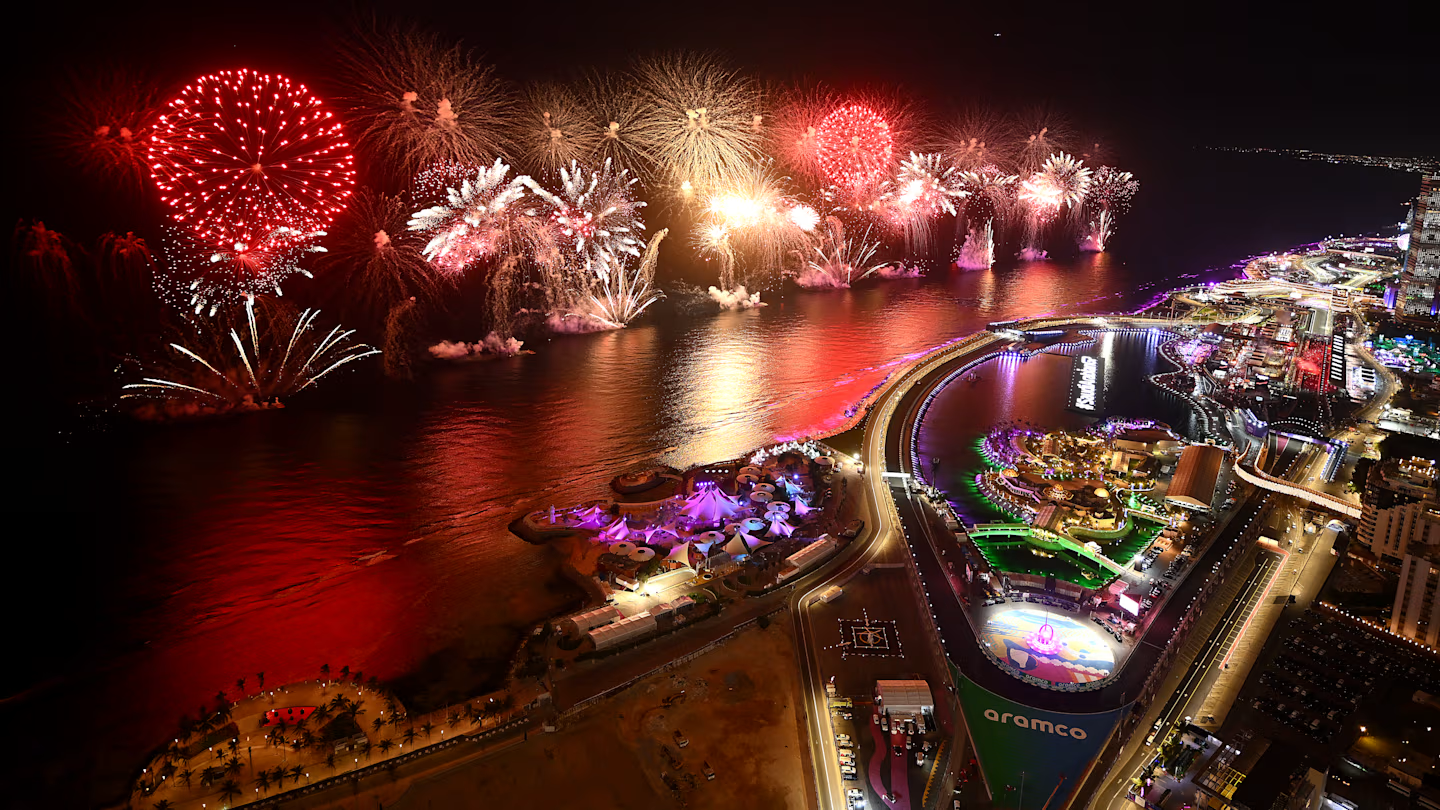
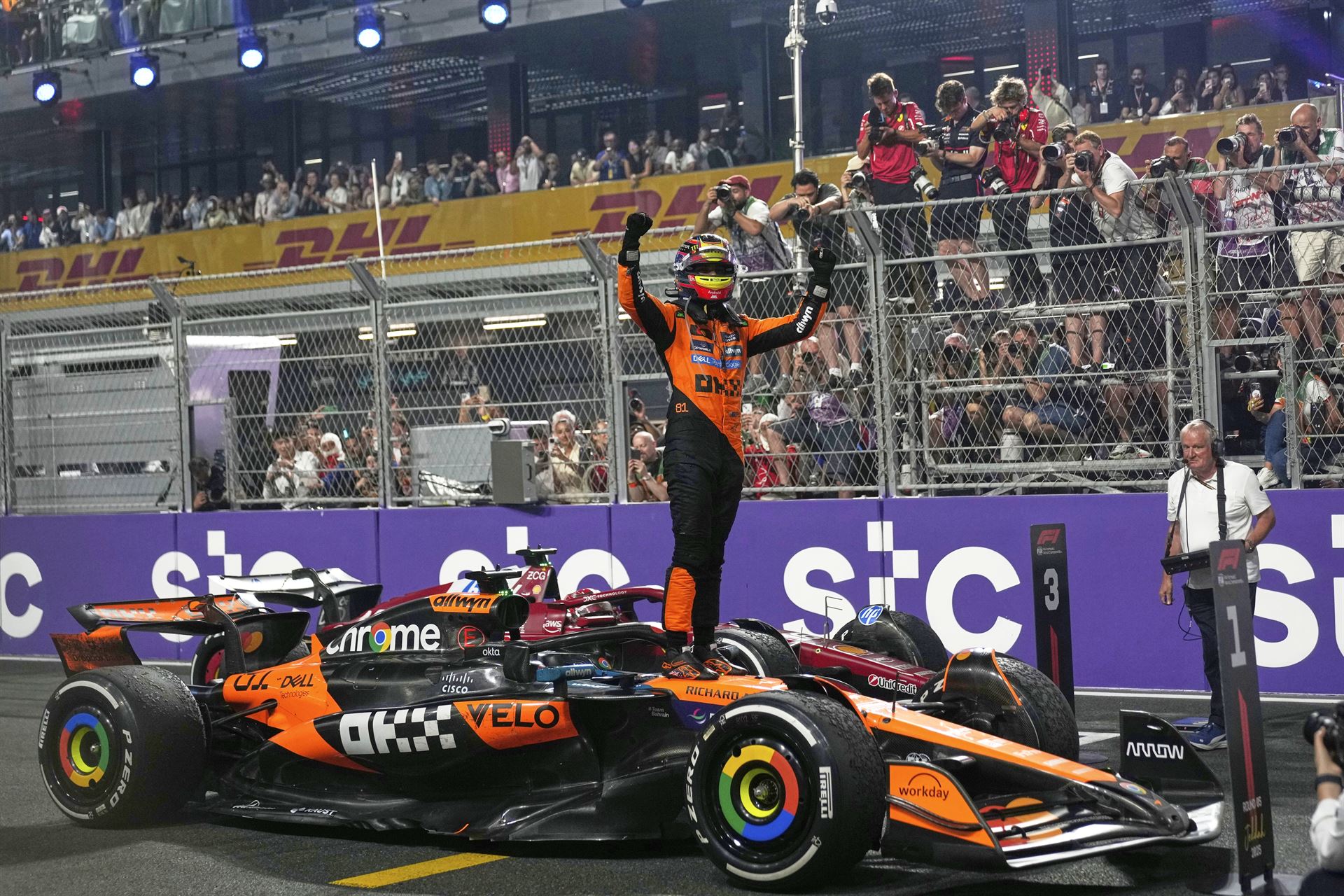
(Saudi GP (F1 Website) Piastri winning 2025 GP (China Daily HK))
The Jeddah Grand Prix is a polarising track. Some find it technical, exciting and high-speed (there’s the metaphor again), whilst others believe it’s not as challenging as other older, more traditional tracks, and that the DRS layout ruins the race. If you want to take a professional’s opinion, Lando Norris thinks it’s “a really fun circuit”. What will be a relief for the Saudis is that the race doesn’t lack heart, as it’s known for being a thrilling street circuit. What won’t be greeted so well by the nation is, that with like many of their projects, there is heavy human rights criticism. The Guardian reported that before the inaugural event that human rights organisations were demanding that F1 acted to mitigate abuses in the country, whilst the Express reports that in a letter written by Mustafa al-Kjayyat, whose brother was executed shortly before the inaugural event, addressed to F1 CEO Stefano Domenicali, he accused Formula 1 of being a “tool to sports-wash Saudi abuses” and that “this is a regime that silently kills people; trying, convicting, sentencing and executing them in complete secrecy. The silence of bodies like Formula 1 enables this violence and bloodshed”. Whether al-Kjayyat’s strong accusations are true or not, there’s no doubt it was a controversial and risky decision for F1 to host a Grand Prix in a country with as much criticism as Saudi Arabia
Despite the heavy backlash, they clearly think that benefits outweighs the costs. Recently, there’s been reports that Saudi Arabia are interested in owning a team, whilst the Kingdom is one of the biggest growth markets in F1, with a more than quarter increase in fans watching the sport in the last year alone. The Jeddah Grand Prix is a polarising topic, not just track. Yes, it may highlight some of the issues Saudi Arabia faces in how the world sees them, but it also attracts the complete attention of the 826.5 million Formula 1 fans around the globe for one weekend a year, where they watch a race which is generally viewed as being intense, high-speed and exciting. Even with its controversy, the Saudi government will view their investment into F1 as a success due to its impact on people within and outside the state, whilst the racing organisation will also see it as being advantageous due to the huge growth the sport has seen in popularity since the Grand Prix’s introduction.
World Cup Saudi Arabia 2034
11 hours before the submission deadline for bids to be lodged to host the 2034 World Cup, Australia withdrew from the process. It was a decision that many football fans were disappointed in, but most accepted. They’d spend $46 million on a bid for the 2022 edition of the tournament (hosted by Saudi neighbour Qatar), only to get a single vote in one of the biggest sporting controversies of all time. More than ten years later, it only took common sense to see they were facing a similar scenario. FIFA had already relaxed their stadium requirements for a bid (a strange coincidence given that the decision would allow Saudi Arabia to campaign for the tournament) and it was quite well known that they already had a favoured candidate. What infuriated the public most however, was just how nicely things fell into place for the Middle-Eastern nation- the rumoured decision to give the opening three games of the 2030 World Cup to Argentina, Paraguay and Uruguay as part of a centenary celebration, but the rest of the tournament to Spain, Portugal and Morocco basically caused the Saudi Arabian bid to not only be the main candidate, but the only one. The 2026 edition will be hosted in North America, leaving Asia and Oceania as the only continents eligible by the eight-year rule. This meant that by the time Gianni Infantino announced FIFA’s usually huge decision, it was already a foregone conclusion.
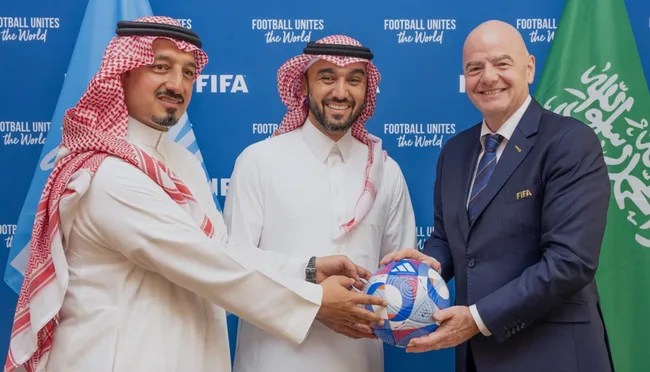
If it wasn’t for this, the public outcry would have been even larger- Sky Sports’ Kaveh Solhekol said “it’s a bad look for FIFA”, whilst most human rights groups absolutely slammed the decision (a common theme when the Kingdom announce major sporting decisions). President Gianni Infantino has also been hugely criticised for being too friendly with world leaders- think Donald Trump and his friend “Johnny Infantino”- and the Crown Prince Mohammed bin Salman is also one of those figures. The Guardian reported that a group of leading lawyers had submitted a 30-page complaint to FIFA outlining that the federation have allegedly failed to follow its own human rights rules in relation to the 2034 World Cup. Criticism is no doubt partly fuelled by the intense scrutiny of Qatar before, during and after the 2022 tournament. Numerous migrant workers died in extremely poor living conditions throughout the construction of entirely new stadiums, whilst the whole process of Sepp Blatter allegedly accepting bribes for the country to win the vote in the first place is viewed as one of the darkest days in footballing history.
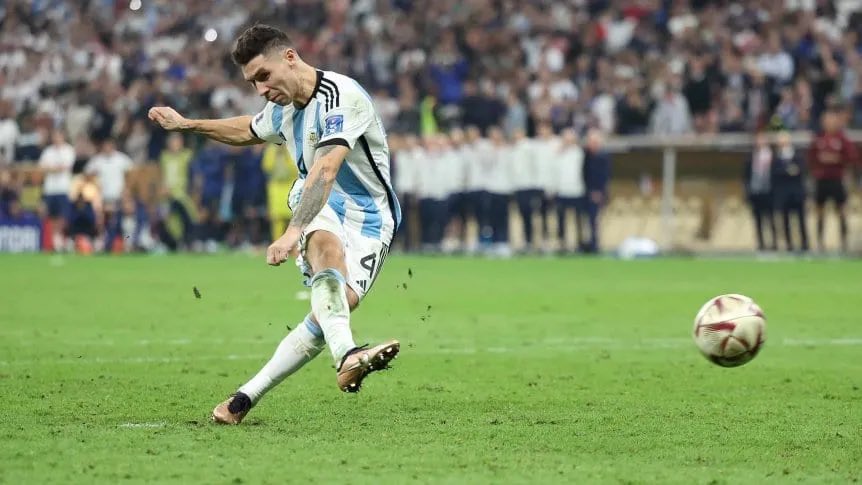
(Infantino with Saudi officials (AGBI) Montiel taking penalty to win Qatar 2022 (X))
Despite this, for Saudi Arabia, the 2022 Qatar World Cup is a key reason their desire the host the 2034 tournament. From the 20th November to the 18th December 2022, the world’s eyes were fixated on what is often viewed as the greatest and most entertaining World Cup ever seen from a storyline perspective. The Saudi FA will be spurred by this, wanting not just the same but better. When Gonzalo Montiel scored the decisive penalty kick of a thrilling 3-3 Argentina-France final, the majority of the 1.5 billion people watching from around the world weren’t thinking about why there’s an argument for the tournament being incredibly morally wrong, they were thinking about how Qatar had gifted the world such an entertaining World Cup with so many great moments. For Saudi Arabia, the 2034 World Cup is the biggest jewel in the crown of their sports projects. It’s the biggest chance for the ultimate “promotion of a positive public image”. If they are sports-washing, then there’s no vaster stage for it than the most-watched sporting competition in the world. Like I mentioned in the Formula 1 section, they will always have critics and come under intense scrutiny, but this is because the nation is viewed a certain way by the West- a way they feel obliged to use sports to change. Perhaps it doesn’t rapidly improve the lives of the nation’s people as projects like Vision 2030 and the Line aim to do (both will be discussed later in this series), but it does give them a greater sense of national pride. Saudi Arabia have clearly realised how effective sports can be in improving how people see a nation and in time their alleged “sports-washing” will, wrongly or rightly, probably bear fruition.
Feel free to subscribe in order to receive an email when the next article of the series is out!
Reader’s Voice
I would be delighted to hear reader’s opinions on how Saudi Arabia is allegedly using sports-washing to alter people’s perspective on the Kingdom. The answers will be put together in a “Readers Voice” post, and the username specified will be included above the quotation unless USERNAME is written in the following box. Answers from readers may have to be trimmed for size or relatability, and words that shouldn’t be featured in the blog will be replaced by more respectable ones. There is no guarantee all quotations will be selected.


 Your World Explored
Leave a comment