
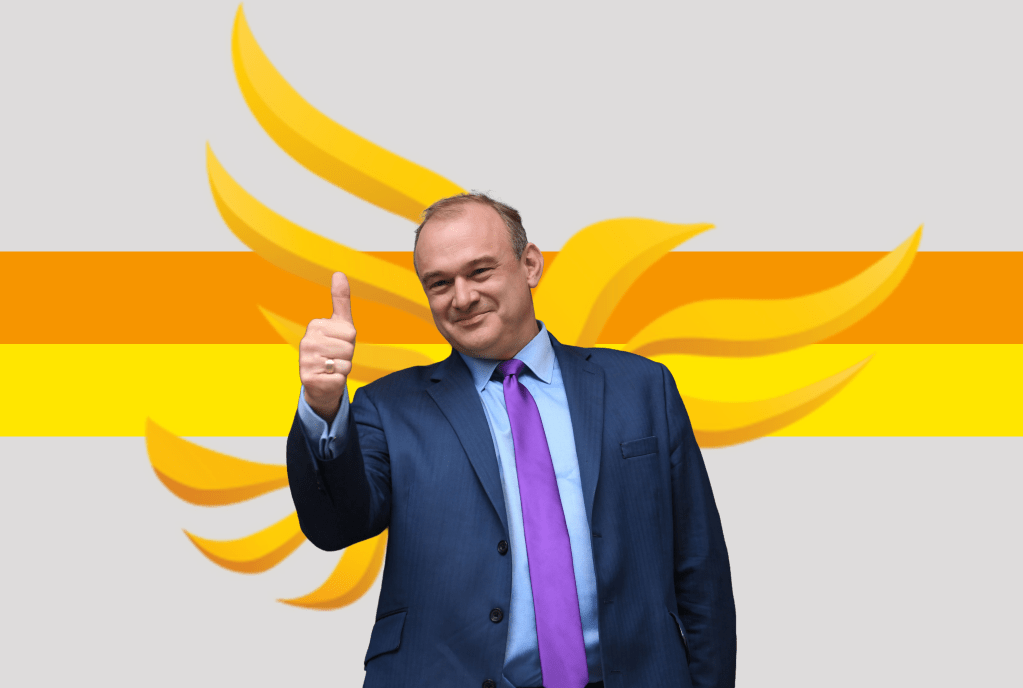
What is the point of the Liberal Democrat Party?
They have forever been the eternal bronze medallists, yet when the Tories and Labour finally stumble together, the Lib Dems are not ready for the grand, sweeping overtake. 2024 was a monumental year for the party- Conservative shortcomings allowed them to snatch many of their southern constituencies, amassing a record seventy-two seats.
This targeted, “Japanese knotweed” approach meant they were able to get sixty-one more MPs into parliament just by increasing their total number of votes by 0.6%. Deep underlying problems remain. Their new strategy also means that they came second in only twenty-seven constituencies, meaning vast improvement in 2029 is unlikely- this could be the Lib Dems ceiling, but should it be?
Years have been spent in the shadows of Britain’s two major forces, but as the Tories and Labour begin to wane, the insurgent Reform and Green parties are the ones who have taken advantage. Stunningly, as the everlasting third placers see the top duo flounder, they have dropped to fifth.
Despite a recent tightening of their immigration stance, much of the general population remain unsure on what the Lib Dems truly stand for. They have put together a strong healthcare emphasis, European standpoint and attitude towards the MAGA movement, but that isn’t enough to convince people you can run the country.
Ed Davey’s position is one of the safest in British politics, however his presence doesn’t exactly invigorate optimism for the future of the party. Even with record seats, the Liberal Democrats have stagnated at around 15% in YouGov polls throughout the last year, and Reform, who won just five seats in 2024, but admittedly more received more votes, have seized the media limelight, a sacred quantity that has escaped Davey’s party for decades.
It is far from crisis point for the Lib Dems, but in the face of record election results, they have failed to capitalise. Despite their seventy-two-seat haul, the same frustrating problems remain, as they continue a struggle that has plagued them since 1988.
In frank terms, the media don’t care about the Liberal Democrats. They just aren’t interested. In an attempt to emerge from the depths of attention darkness, Davey has adopted a quite unorthodox tactic- public stunts. Whether its paddle-boarding on Lake Windermere, hurtling downhill on a bike in Powys, or a “slip n slide” in Somerset, the Lib Dem leader has embarked on a strangle campaign geared towards grabbing attention and intrigue.
Whilst those activities may sound random, they are geared towards highlighting policy, however it once again lacks clarity and precision, fitting into the narrative of confusion that surrounds the party. The strategy worked in 2024, as they won an unprecedented number of seats in a post-Scottish dominance world, but as we reach 2026, it has gone too far.
This childish technique has now led to an inevitable view that the Lib Dems are woefully unserious. Social media has been weaponised to great success by their left and right-wing rivals, but this is through bite-sized, targeted and curated messaging, rather than videos of their leaders clumsily flopping into the cold waters of the Lake District.
The Liberal Democrats are trapped in a vicious electoral cycle. The campaign airtime each party receives is calculated with a combination of historical reputation and current polling, meaning that they need support to gain coverage, but coverage to gain support. First past the post is often pinpointed as the party’s biggest problem, but as Reform and the Greens have taken the fast lane to speed past them, are the largest issues actually within the Lib Dems?
Huge emphasis has been put on healthcare in recent years, with 2024’s manifesto promising free personal care in England, 8,000 more GPs, and a 62-day guarantee for those requiring cancer treatment. This is an issue that consistently ranks third behind immigration and cost of living as the biggest problems facing UK politics. Whilst Reform and the Conservatives have positive reputations for our borders and economy respectively, the Lib Dems have moved to champion our medical system, giving them precious relevance at the highest level.
They have reaffirmed their position on the left of the spectrum in recent years, placing special prominence on climate change, welfare and criminal justice reform in their manifesto- as Starmer’s Labour move right-wards, the Lib Dems have even leapfrogged their rivals in some places.
This is a growing issue that could develop throughout the coming year. When Labour have a Corbyn-like, more hard-line socialist figure as their leader, the Lib Dems place in UK politics is clear- a moderate presence slightly to the left of the spectrum, that disillusioned centre-standing Tories and Labourites can drift towards. However, when they have a more Blair-like leader in ideological terms, such as Keir Starmer, it feels increasingly noticeable that Labour and the Liberal Democrats are operating in a very similar space.
History and reputation tell us, that unless the red side capitulate, the majority will not vote orange. Labour’s positioning highlights another problem for Davey’s party- the Greens. Under Keir Starmer’s leadership, the vast majority of dissatisfied left-leaning voters have raced towards the open arms of Polanski, as he offers the radical change that a party relevant since 1988 cannot.
Much of the UK population are sick of the conventional, and hungry for change. Throughout the last thirty years, the Liberal Democrats’ position as the Conservative-Labour alternative has rarely been questioned, but as these two institutions face all-time lows, people are beginning to speculate.
The current political climate just doesn’t support the Lib Dem viewpoint. Despite this, they will likely escape widespread scrutiny- the moderate voters who chose the party in 2024 will probably maintain their choice into 2029, as the failings of the Tories and Labour push them away like a bad odour. Also, for most of them, Polanski and Farage may be too extreme. However, just as much as they won’t lose swathes of 2024 voters, they won’t gain them either, as those who opted for the traditional “big two” last time are far more likely to be drawn into the radical revolution.
For this poll-backed stagnation to be halted, their dividing stunt strategy may need to change. Research by More in Common suggests that 61% of Britons believe Davey’s antics make them appear less serious, with only 21% believing they are a good way to grab attention- startingly, nearly half of Lib Dem followers believe they are inappropriate. Clowns are meant to grab people’s attention and make people laugh, but how often do you see or remember the face under the mask?
Followers will say that his foreign affairs speeches prove he can be serious, but Davey’s strategy has created an image of him being “an embarrassing dad” and “a nice guy”. It is clearly a quest to make him appear more relatable and personable, but could the average person on the street run the UK?
The Lib Dems have looked to combat populism, Reform and the MAGA movement, but the rapid emergence of Polanski’s Green Party has dampened the idea of a Farage-Davey head-to-head. Stunt antics have been toned down in recent months, yet their leader still lead a marching band in his entrance to the party conference- most will remember that, but not the speech he made.
There is of course hope for the Liberal Democrats. Even when an outlet covers the party in a negative light, it often comes below a picture of Davey looking happy. Most of their 2024 seats are very defensible, meaning 100 seats is a realistic target for 2029, whilst they remain very good at growing local, grassroots support.
Despite this, it is the same old problems that plague the Lib Dems. Few know what they really stand for, few would have confidence of them in government, and few take them seriously. Conservative and Labour shortcoming has handed the party a golden opportunity, but they have failed to seize it. The current climate means this may even be out of their control.
In a puzzle of UK politics, many believe that the Tories and Labour are failing to provide jigsaw pieces, whilst their extreme counterparts Reform and Green do the opposite. The problem for the Liberal Democrats is that they are producing new segments, but they don’t quite fit.
Thanks for reading my latest blog post on Your World Explored by me, Lewis Defraine. Feel free to offer your support, or even constructive criticism in the comments section below. A like would be greatly appreciated, and if you’d like to receive more articles from Your World Explored, you can also subscribe. Also, you can take part in the poll down below.

 Your World Explored
Leave a comment