
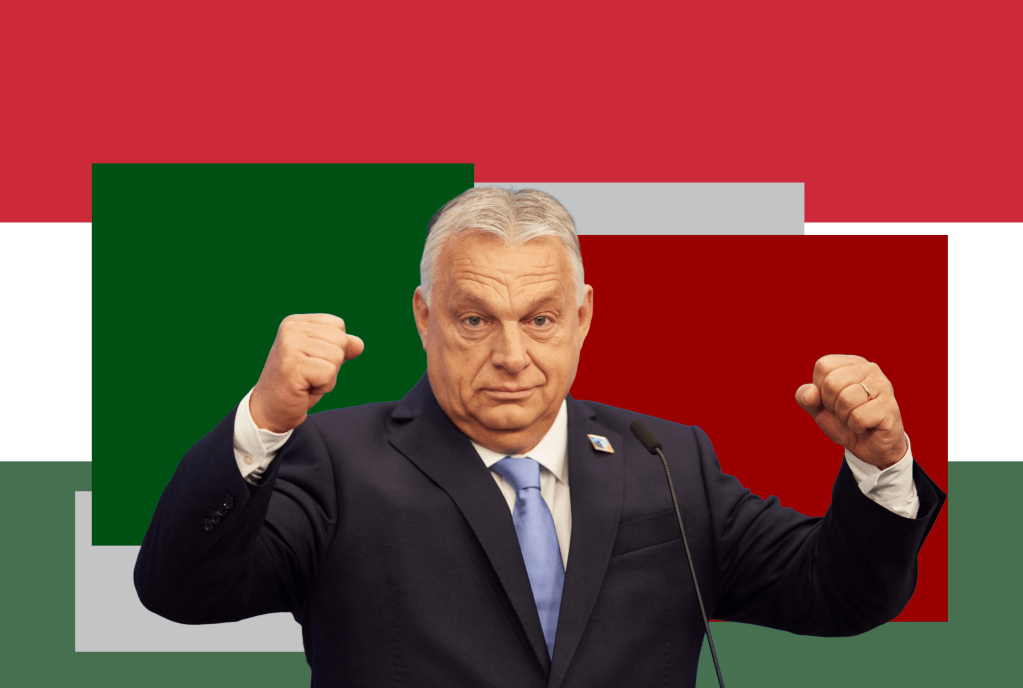
The 28th July 2025. Hundreds of thousands of people march through the streets of Budapest celebrating gay pride, free speech and the right to assemble, despite Prime Minister Victor Orban’s rigorous attempts to target his nation’s LGBTQ+ community and stop Pride altogether. The 10th February 2024. President Katalina Novak resigns following a scandal where it arose that she pardoned a man alleged to be a paedophile, greatly tainting Orban’s proud image of being a defender of traditional family values. Cracks are beginning to rapidly form in the 15-year iron fist of Viktor Orban, a man who’s transformed Hungary to an “illiberal state”, cast away from its fellow EU members.
Viktor Orban and post-communism Hungary have often come together. He set up his party, “Fidesz”, whilst still at law school, as the Soviet Union began to collapse in the late 1980s. It was in 1989 where he first showed hints of being a future leader, delivering an audacious seven-minute speech in Budapest calling for the Red Army to go home. Orban soon realised that in order to be successful, he would have to turn his back on liberalism and remodel Fidesz into a nationalist, anti-liberal force, as Hungary’s ruling party at the time was liberal-socialist.
By 1998, it appeared that this change had worked like a charm. Viktor Orban led Fidesz to election victory, becoming Europe’s youngest prime minister at thirty-five, before leading Hungary into NATO a year later. The Prime Minister was met by defeat in both 2002 and 2006, however he has said that he “learnt his lesson” on both occasions.
2010 Hungary was a turgid, turbulent state. The year’s infamous financial crisis was enough to sweep Orban right back into office, and since then, he certainly hasn’t looked back, with a dynasty of election wins, appearing to tighten his iron grip of the nation on each occasion.
There’s no doubt that Orban is a highly intelligent, charismatic and quick-thinking individual, with a cornerstone of his election wins being the identification of what his voters fear, however there’s also no denying that the prime minister has used his immense power as means of staying in office.
Control over two thirds of parliament has given him the ability to transform Hungary with changes to its laws and constitution, whilst the nation has become increasingly authoritarian throughout Orban’s fifteen consecutive years of power. Hungarian media monitor Mertek say that the Fidesz party have gradually replaced foreign investors and taken control of the state’s media landscape- allegedly, all “Orban-friendly” media was transferred to Kesma in 2018, a foundation whose board is made up of Fidesz MPs.
A common feeling from the outside looking in on Hungary is that it is a rare example of an EU state that has gone backwards in terms of democracy. Viktor Orban has religiously attacked the liberal worldview for decades, however even he seems unsure on what to call his creation, flirting with titles “illiberal democracy” and “Christian liberty”.
The European Council doesn’t appear to agree with those names on grounds of democracy, with their declassification of Hungary being from a “full democracy” to a “hybrid regime of electoral autocracy”. This is the same as Russia and Turkey, which sums up a feeling that Orban’s Hungary are on a similar path to what fellow long-term leaders Putin and Erdogan have taken their states.
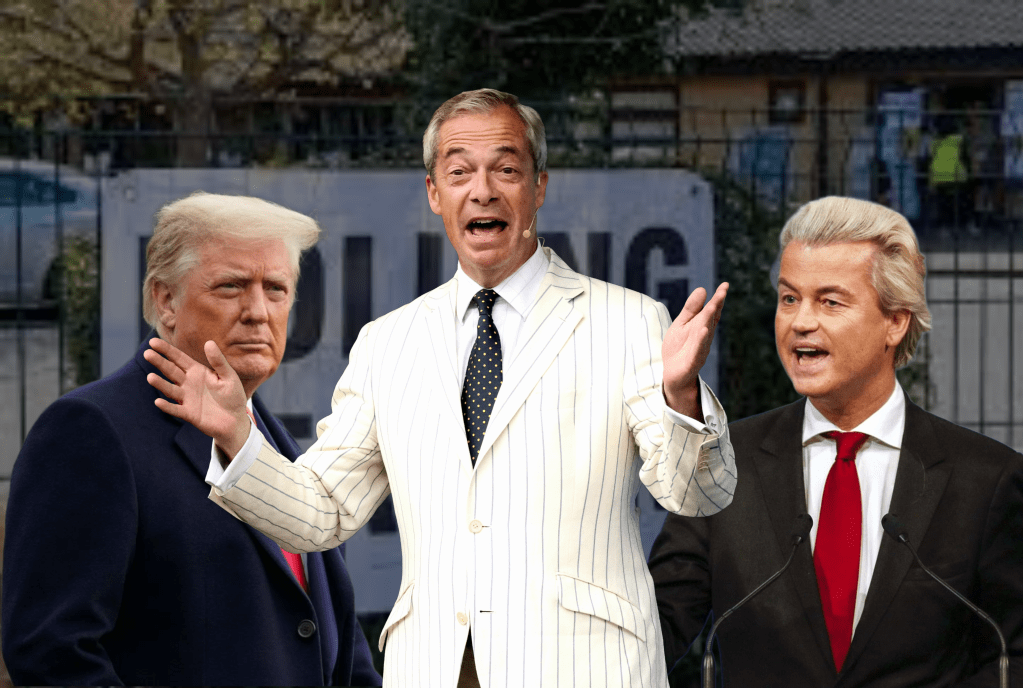
Despite Hungary’s backwards democratic direction, Viktor Orban has drawn admirers from around the world, including US vice president JD Vance, AfD leader Alice Weidel, PVV leader Geert Wilders and Georgian PM Irakli Kobakhidze. Most notably of all, Donald Trump said that Orban is “one of the most respected men, they call him a strong man” in September 2024. Many of Trump’s MAGA Republicans hugely admire the Hungarian for his confrontation of “woke” culture.
It’s pretty plain to see why Orban is a man who divides opinion. He’s a very successful and powerful leader, who has tightened his grasp over Hungary in a way that it’s now hard to picture them apart. He rules by bullet points- simple messages culled from unpublished government opinion surveys that aim to find out the public’s worries. Pro-government media, social media and nationwide billboards then reciprocate these messages. Another major part of his success is a “winner takes all” attitude- after returning to office in 2010 Orban shrank parliament from 386 seats to 199, and abolished the second round of elections, which channels votes to the strongest party. Fractious opposition parties then fought against each other in the following elections, whilst Orban’s Fidesz strolled into parliament with swathes of the vote.
Viktor Orban is also a man of great controversy, with severe allegations to answer to. Hungary continues to fall lower and lower in press freedom rankings, whilst no longer being a full democracy isn’t an allegation anymore, it’s a proven fact. The prime minister appears to be willing to go further than ever to maintain power, with Fidesz-friendly judges filling the Constitutional and Supreme Courts, as well as new legislation that would give authorities the power to “strangle and starve” non-governmental organisations and independent media.
The views of Orban have also been heavily questioned. He is strictly conservative, if not far-right, with hard-line views on immigration and the inhabitants of his state. The government has long had an idea of who is a “proper” Hungarian and who isn’t, and this image is one that’s getting more and more narrow. Migration has become a bread-and-butter issue for Orban. When hundreds of thousands of refugees and migrants crossed Hungary’s borders in 2015, he drew a clear link between illegal migrants coming to Europe and the rise in terrorism. A fence was then built on the Serbian border in 2018 and new laws were introduced criminalising migrants, and those who help them.
“I said guys you can create whatever migration system you would like to do, but don’t force Hungary to do the same thing, because we simply don’t believe. We think that mixture of the two civilizations will not result in good things.” Those were the words of Viktor Orban at the controversial National Conservatism Conference Brussels 2024 (NatCon), addressed to the EU. The two “civilizations” he was talking about are Christians and Muslims. Orban has quickly become one of the most outspoken people in modern politics, and he has a habit of stating his personal beliefs as the ones of the entire Hungarian population.
Some of the biggest criticism of Orban isn’t due to the system he has implemented in Hungary; it is his beliefs themselves. The prime minister has been accused of anti-Semitism on many occasions, dodging allegations by pointing out his friendship with Benjamin Netanyahu and support for Israel. He has sternly rejected the much-embraced idea of a mixed society, with some of the EUs most hard-line stances on immigration and pretty concerning views on the “proper” Hungarian.
Viktor Orban’s views often have him cast as a solitary figure at EU summits, and in Western politics as a whole. Despite apparently being in favour himself, Hungary is the only nation in opposition to Sweden’s admission into NATO. For someone whose political standing is rooted in the fall of the USSR, Orban’s friendship with Vladimir Putin is quite peculiar. Hungary is closer to Russia than any other EU state, as is its leader, who has staunchly argued that the union is going in the wrong direction on Ukraine, as he believes Kyiv can never win the war.
As mentioned previously, it is highly unusual for a 21st century European nation to go backwards in democratic terms, and this is something the EU certainly isn’t pleased with. Ahead of the 2019 European elections, a leaked recording revealed that one of Hungarian broadcaster MTVA’s senior editors had instructed those in charge to follow “the appropriate narrative, method and direction, mostly about migrants and Brussels”.
The EU’s top court ruled that Hungary had failed to fulfil its obligations under EU law, which was one of many rulings against the state, climaxing in the suspension of EU funding for the nation for breaking EU laws. Orban himself once described Hungary as a “petri dish for illiberalism”, backing the general feeling that he is an anomaly of sorts in modern politics. Of course, the rise of far-right parties in Europe could put more and more people with views like his in high positions, however Hungary and Orban remain very much as exceptions to a pretty good rule at this moment in time.
Throughout this article, I’ve talked about the iron fist that Viktor Orban pressed upon in the last fifteen years. For much of that time, it has appeared an invincible, all-ruling one, largely due to the self-benefitting changes that the prime minister has made during his reign.
However, from the midst of a pardon scandal, LGBTQ+ march, and general stalling of Hungary’s economy, a new challenger has emerged- it’s a man formerly of Orban’s inner circle, Peter Magyar. February 2024 not only saw the resignations of male-dominated Fidesz’s two female role models, it also saw a bombshell statement from new opposition. 44-year-old Magyar gave a lengthy interview to premier opposition YouTube channel Partizan, blasting alleged nepotism and corruption within the governing party.
Admittedly, Magyar has treaded carefully so far, with Fidesz officials and certain media sectors attempting to portray him as a liberal, or leftist (he is centre-right). He is trying to not alienate his conservative rural base, which until recently was Orban’s uncontested key to election victory. Crucially, and most stunningly, Peter Magyar has painted a formidable new image of Hungary- one of a collapsing, failing state.
He has toured the government almost continuously, assiduously and brutally attacking the government over the dire state of state hospitals, schools and railways, as well as the nation’s public service wages, which are amongst Europe’s lowest. Scarily for Fidesz, Magyar has quickly gathered large widespread support, drawing big crowds and an often-bigger Facebook following- many if his visits are often broadcast on the platform.
It appears that the once calm and collected Viktor Orban is beginning to sweat under the pressure. He is beginning to make embarrassing mistakes, notably backing ultra-nationalist candidate George Simion in the recent Romanian presidential election, considering him as a useful European Parliament ally, forgetting that he has a long history of anti-Hungarian remarks. However, the war in Ukraine could be a welcome issue for Orban to grasp in the lead up to 2026’s election- it 2022, he portrayed himself as the “peace candidate”, claiming that his opposition would drag Hungary into the war. For a nation that has been overrun by foreign armies many times throughout his history, this was a clever tactic.
Orban’s good relationship with Vladimir Putin has also been delineated as a guarantee of cheap gas and oil for Hungary’s population, however the prime minister has failed to prevent any of the EU’s 18 sanction packages against Russia as of yet.
Despite the possible saving grace of his Russian relations, Hungary’s ominous economic future could be the nail in Orban’s coffin. The nation is heavily dependant on the German market, in particular German cars manufactured in the country, and there’s an ever-increasing feeling of stagnation. There’s also rapidly growing idea that Viktor Orban can no longer deliver an improved standard of living.
Most national polls suggest that Magyar’s party, Tisza, is between 9% and 18% ahead of Fidesz. The new opposition now has two million followers, which similar to Orban’s core electorate- more five million Hungarian’s voted in the 2022 election (69% turnout), creating a scenario where 2026’s victor will be decided by the currently uncertain. Opposition activist Puzser described Hungary as being at a crossroads, with one path leading the nation back towards a Magyar-led return to full democracy, and the other edging the state closer and closer towards a possible Orban-led dictatorship.
After 15 years of power, the defeat of Viktor Orban in 2026 would be monumental. The Hungarian’s bullet-point style and winner-takes-all mentality has transformed his state into his own creation, a nation forged in his own image. He’s a man that stands proud as an anomaly, a sore thumb in European politics, yet there’s a growing contingent within Hungary calling for change. This backwards-leading experiment in which the state has gradually become more authoritarian appears to now be failing, and it’s at risk of blowing up in Orban’s face. The emergence of Magyar, the Pride march, pausing of EU spending, and pardon scandal have rocked his ideas, and led many to question their long-term legitimacy. Perhaps Orban’s intelligence and reputation will give him an edge in 2026, but this is a far cry from the all-powerful super-majorities that he once claimed, and there’s a sense of inevitability that his tenure will soon end, as his ideas become untenable.
Hungary is a television series admired by much of the world, and Viktor Orban is its outright star. The rest of its cast however, are beginning to want him replaced.
Thanks for reading my latest blog post on Your World Explored by me, Lewis Defraine. Feel free to offer your support, or even constructive criticism in the comments section below. A like would be greatly appreciated, and if you’d like to receive more articles from Your World Explored, you can also subscribe. Also, you can take part in the poll down below.
Key sources-
https://www.bbc.co.uk/news/world-europe-67832416

 Your World Explored
Leave a reply to Scrivener Cancel reply