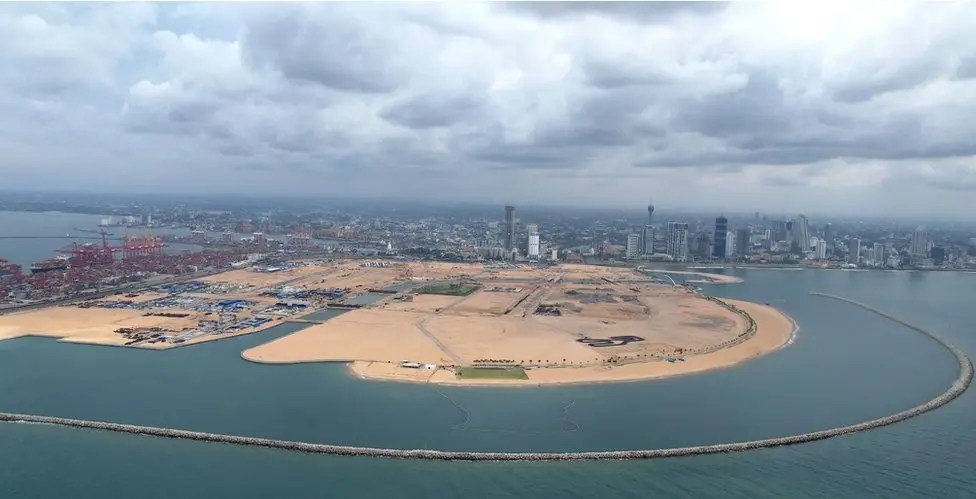
As I zipped through the bustling streets of Colombo on a tuk-tuk tour this summer, a seemingly unassuming landmark captivated my attention. Framed by glistening modern infrastructure stands a black-and-white striped tower— the lighthouse of Sri Lanka’s throbbing capital. Built in 1952, it once served as a symbol of Ceylon’s independence, illustrating the nation’s expanding trade importance. The problem, however, is that this lighthouse no longer borders the sea.
There is a complex footnote to the modernisation of “the Pearl of the Indian Ocean”, prompting questions on the reality of its sovereignty. Today, the tower’s beacon illuminates something different— neo-colonialism. A vast, quarry-like expanse of reclaimed land now jars with the cityscape— Colombo Port City, a Chinese-backed development project that promises to become a global finance hub.
Unlike its predecessors, neo-colonialism is not grounded in territorial control, but on the economic and strategic leverage that powerful states exert over independent nations.
I found it astonishing how China is so conspicuously playing in its arch-rival India’s geopolitical backyard, underlining the apparently limitless horizons of the superpower’s ambitious Belt and Road Initiative. Yet Sri Lanka is just one example in a global tug of war for power, as the “rules-based order” is incrementally eroded— a story that will only lengthen as the United States continues to turn inwards.
Africa is one of the most prominent theatres of China’s expanding influence. Across the continent, Beijing’s investment in ports — including in Kenya, Angola, Ghana, Nigeria, South Africa and Tanzania — is broadening Chinese soft power, while creating new opportunities for its economy. In addition, China furnishes these ports, with the country producing 96% of the world’s shipping containers, and 80% of its ship-to-shore cranes.
Beijing’s influence doesn’t end at the coastline. Africa’s connectivity is being improved by a new network of road and rail links, built and funded by Chinese state-owned companies. Although this enhances African nations’ infrastructure, the Belt and Road Initiative is hardly a charity mission. These connections allow Chinese businesses to delve deep into Africa’s treasure-chest, meaning much of the value added to resources may be captured abroad. This dynamic echoes colonial-era resource extraction.
China’s “Going Out” policy is also prominent on the continent, encouraging both state-owned and private companies to expand into foreign markets. Beijing’s leverage in Africa’s energy sector is broadening, reinforced by its funding of hydroelectric dams in Ethiopia. This strategy is multifaceted, enabling China to absorb domestic industrial overcapacity, while expanding overseas markets for its green exports.
Few countries demonstrate the scale of China’s overseas investment clearer than Laos, its landlocked neighbour of just 7.5 million people. Beijing’s flagship Laotian project is a striking feat of engineering— a high-speed railway that condensed a two-day journey into a three-hour trip. It is accompanied by numerous hydroelectric dams, transport links and settlements, alongside significant investment in mining, agriculture and telecommunications.
Yet, whilst Beijing’s partnership with Vientiane showcases the reach of its neo-colonialist ambitions, Laos also exposes the dangers of growing economic dependence on China. The country is in profound economic distress, driven by soaring inflation and currency depreciation. With most products imported, the crisis is having an immense impact on everyday Lao life— farmers can no longer afford fertiliser, children are leaving school to work, and families are cutting back on healthcare.
Why? Because total debt exposure exceeds $12.2 billion— equivalent to 65% of GDP. As Vientiane struggles to shoulder the burden of its borrowing spree, the state is seeing its sovereignty undermined. Chinese secret agents and police can operate in Laos, whilst Beijing holds some control over the Lao electricity grid.
The steady slide of entire nations into puppet dependence is not just the West’s problem. Polls suggest anti-China sentiment has grown in Laos— a majority of the population now prefer the USA, a country that dropped around 270 million cluster munitions on its territory during the Vietnam War.
More alarmingly, China’s quiet advance extends beyond trade. Many of its new ports are dual-purpose, capable of being quickly modified to allow warships to dock and resupply. In Djibouti, Beijing has strengthened the ability of its People’s Liberation Army Support Base to monitor activity across the region.
The base serves as a pivotal springboard for Chinese naval operations in the Gulf of Aden and the Red Sea— it is located near the Bab el-Mandeb Strait, a crucial trade chokepoint. New antennas and satellite communications could improve intelligence-gathering on nearby American, French, Italian and Japanese installations, particularly as Houthi-driven conflict in Yemen sharpens the focus on the area.
Neo-colonialism is driven by spheres of influence. On the African stage, Putin is forging unlikely alliances with military dictatorships in the Sahel, a region long shaped by French rule. Russia is seizing upon anti-colonial sentiment to amplify its soft power— the Russian tricolour now often flies alongside national flags in Burkina Faso, Mali and Niger.
Putin’s foothold is strengthened by the Africa Corps, whose conflict with Islamist extremists has established a Russian military presence in the area. Whilst the fight against terrorism benefits regional security, the Africa Corps also supports military juntas, with allegations of atrocities continuing to surround its operations.
In former French colonies, the desire for greater sovereignty may lead governments into Putin’s arms. The consequences extend beyond Africa— instability in the Sahel can increase migration pressures on Europe, potentially serving the Kremlin’s interests.
The evolution of colonialism has created fresh complexities— it is not solely superpowers that are drawing new invisible borders. The United Arab Emirates is a major investor in Africa, pouring in $50 billion alone in 2022. Seeking to diversify its oil-dependent economy, the UAE has developed military outposts in the Horn of Africa and become involved in conflicts in Libya and Sudan.
In an age of globalisation and national independence, it has been assumed that colonialism belongs to the past. This era was expected to drive exponential growth in interconnectivity, while economic integration was anticipated to foster political liberalisation. Yet the persistence of colonialism exposes the fault lines in these premises.
Rather than relying on territorial conquest, modern colonialism exploits economic disparities through financial leverage, resource extraction and strategic infrastructure. The result is an erosion of sovereignty under the guise of mutual benefit, leaving weaker states increasingly dependent on external powers— formal independence no longer equates to genuine autonomy.
Neo-colonial forces are fracturing the rules-based order that underpins modern geopolitics. As Europe falters and the United States retreats, whilst China continues its ascent, these tensions will only intensify.
The world must acknowledge an uncomfortable truth— colonialism is not over. Those who doubt it need only to visit Colombo’s magnificent lighthouse— and gaze out across the reclaimed land, where the sea once met Sri Lanka’s shores.
Thanks for reading my latest blog post on Your World Explored by me, Lewis Defraine. Feel free to offer your support, or even constructive criticism in the comments section below. A like would be greatly appreciated, and if you’d like to receive more articles from Your World Explored, you can also subscribe.





Leave a Reply